Asphalt vs Concrete Driveway: Which Lasts Longer on Long Island?

Not sure whether asphalt or concrete is the right call for your driveway? Here's what Nassau County homeowners actually need to know before deciding.

Share:

Creating Beautiful and Functional Outdoor Living Spaces with Bricks, Stones, and Concrete Blocks

Masonry in landscaping is essential to designing and constructing an attractive and functional outdoor living space. Masonry is the art of building structures using bricks, stones, and concrete blocks. It is an ancient trade that has been used for centuries to create structures that are both functional and aesthetically pleasing.

Landscaping is the process of designing, planning, and creating attractive, functional, and sustainable outdoor living spaces. It involves the use of plants, water features, lighting, and other elements to create an outdoor environment that is both beautiful and practical.

Masonry plays a crucial role in landscaping as it helps to create a solid and durable foundation for various outdoor living features such as patios, walkways, retaining walls, fireplaces, and water features. In this blog, we will explore the various ways masonry can be used in landscaping and the benefits it provides.

Patios

Patios are outdoor living spaces typically made of concrete or stone. They are a popular feature in landscaping as they provide a comfortable area for dining, entertaining, and relaxation. Masonry is an ideal material for creating patios as it is durable, low-maintenance, and can be customized to suit any design style.

Masonry patios can be made using a variety of materials such as bricks, stones, and concrete blocks. These materials can be arranged in different patterns and designs to create an attractive and attractive outdoor living space. Masonry patios are also resistant to weathering, erosion, and pests, which makes them a practical and long-lasting option.

Walkways

Walkways are paths that lead from one area of the outdoor living space to another. They are typically made of concrete, stone, or pavers and can complement the overall landscaping design. Masonry is an ideal material for creating walkways as it provides a solid and stable surface that can withstand heavy foot traffic and the elements.

Masonry walkways can be made using a variety of materials such as bricks, stones, and concrete blocks. These materials can be arranged in different patterns and designs to create an attractive and attractive walkway that complements the overall landscaping design. Masonry walkways are also low-maintenance and can be easily cleaned and repaired if necessary.
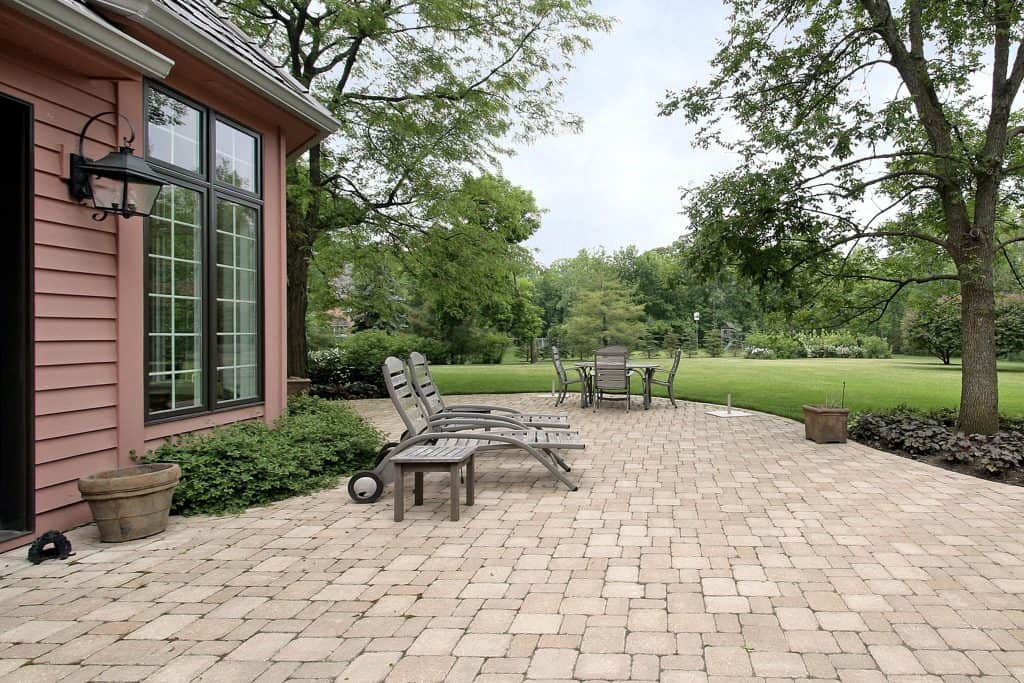
A spacious brick patio, expertly crafted by a masonry contractor Long Island, NY, features lounge chairs and a dining table set. It’s bordered by a red house and overlooks a large green lawn with trees in the background.

Retaining Walls

Retaining walls are structures designed to hold back soil and prevent erosion. They are a crucial feature in landscaping as they help maintain the integrity of the outdoor living space. Masonry is an ideal material for creating retaining walls as it is strong, durable, and can be customized to suit any design style.

Masonry retaining walls can be made using a variety of materials such as bricks, stones, and concrete blocks. These materials can be arranged in different patterns and designs to create an attractive and attractive foundation wall. This complements the overall landscaping design. Masonry retaining walls are also low-maintenance and durable, making them a practical and long-lasting option.

Fireplaces

Fireplaces are outdoor living features that provide warmth and cozy atmosphere for dining and entertaining. Masonry is an ideal material for creating fireplaces as it is heat-resistant and can be customized to suit any design style.

Masonry fireplaces can be made using a variety of materials such as bricks, stones, and concrete blocks. These materials can be arranged in different patterns and designs to create an elegant and attractive fireplace. This complements the overall landscaping design. Masonry fireplaces are also low-maintenance and durable, making them a practical and long-lasting option.
Summary:

Choosing between asphalt and concrete isn’t just about price — it’s about what holds up in your specific climate, on your specific property. Nassau County’s freeze-thaw winters, heavy road salting, and coastal moisture make this decision more consequential than most national guides let on. This post breaks down the real differences: upfront cost, long-term maintenance, how each material performs through a Long Island winter, and what most homeowners don’t find out until it’s too late. If you’re replacing a driveway in Nassau County, this is the comparison you actually need.
Table of contents

If you’re staring at a cracked, crumbling driveway and trying to figure out what to replace it with, you’ve probably already Googled this question and gotten a dozen different answers. Most of them are written for a generic national audience — not for someone dealing with Nassau County winters, sandy glacial soil, and roads that get salted from November through March.

The honest answer is: both materials can work well, and both can fail early. What determines the outcome is the material choice for your specific conditions, combined with how well the job is done. Here’s what you need to know to make a confident decision.

Asphalt vs Concrete Driveway: How They Actually Compare

At the most basic level, asphalt and concrete are both paved surfaces — but they behave very differently under stress. Asphalt is flexible, which means it can shift slightly without cracking when the ground moves beneath it. Concrete is rigid, which gives it more compressive strength but also makes it more vulnerable when the ground expands and contracts.

On Long Island, that distinction matters more than almost anywhere else. Nassau County averages roughly 30 to 40 freeze-thaw cycles per year — meaning the ground beneath your driveway freezes, expands, thaws, and settles over and over again throughout the winter. That repeated movement is one of the primary reasons driveways fail. Asphalt handles those cycles better than concrete does.

The other factor most comparison guides skip entirely is road salt. Nassau County roads — county roads, state routes, local streets — get heavily salted during winter storms. That salt runoff onto adjacent driveways causes real damage to concrete over time, leading to surface spalling and eventual structural compromise. Asphalt is considerably more resistant to chloride exposure than concrete is.

How Long Does Each Material Last in Nassau County?

Nationally, asphalt driveways last 15 to 30 years with proper maintenance, and concrete driveways last 30 to 50 years or more. Those numbers hold roughly true for Long Island — but with some important caveats that shift the comparison.

Concrete’s longevity advantage is real, but it depends heavily on installation quality and ongoing maintenance. A concrete driveway that’s poured without proper expansion joints, installed over an inadequate base, or left unsealed in a climate like Nassau County’s will crack within a decade. When you see a concrete driveway that’s buckled or spalled after just a few years, it’s almost never a material failure — it’s an installation or maintenance failure. The material can last 40 years. A rushed, under-specced job won’t.

Asphalt has a shorter lifespan on paper, but it’s more forgiving of the conditions here. It flexes instead of cracking under freeze-thaw stress, it shrugs off road salt better than concrete does, and its dark surface absorbs solar heat — which actually helps accelerate snow and ice melt in winter, a practical benefit that most homeowners don’t think about until they’re shoveling at 7 a.m. The trade-off is maintenance: asphalt needs to be resealed every two to five years to stay in good condition. Skip that, and you’ll watch it deteriorate faster than it should.

The honest comparison for Nassau County looks something like this: a well-installed, properly maintained asphalt driveway realistically gives you 20 to 25 years. A well-installed, properly maintained concrete driveway can give you 35 to 45 years. But both of those outcomes depend entirely on the quality of the installation and the base preparation underneath — which is why who does the work matters as much as what material you choose.

One more thing worth noting: if your property is in Long Beach, Atlantic Beach, Lido Beach, or anywhere along Nassau County’s south shore or north shore coastline, you’re dealing with salt air on top of road salt and freeze-thaw cycles. Coastal moisture accelerates surface oxidation in both materials. In those areas especially, proper sealing isn’t optional — it’s the difference between a driveway that holds up and one that doesn’t.

Asphalt and Concrete Maintenance: What You're Actually Signing Up For

Maintenance is where a lot of homeowners get surprised — usually after they’ve already made their decision. Asphalt requires more frequent attention than concrete, but the individual tasks are straightforward and relatively inexpensive. Concrete requires less frequent intervention, but when problems develop, they’re more expensive to address and harder to reverse.

With asphalt, the primary maintenance task is resealing. You should plan on doing this every two to five years, starting the spring after your driveway is installed. Resealing costs roughly one to two dollars per square foot, so for a standard two-car driveway, you’re looking at somewhere between $900 and $1,900 per sealing cycle. You’ll also want to fill any surface cracks as they develop, before water gets in and freezes — that’s when small cracks become big problems. The total maintenance investment over 20 years is real, but each individual task is manageable.

With concrete, sealing is still necessary — every three to five years — but the bigger maintenance concern in Nassau County is what you put on it. Rock salt, which most homeowners reach for automatically in winter, is significantly more damaging to concrete than to asphalt. If you have a concrete driveway, you need to use calcium chloride or sand instead of rock salt, and you need to seal the surface consistently to limit chloride penetration. Concrete is also harder to patch invisibly than asphalt — repairs tend to be visible, which matters if curb appeal is a priority for you.

Neither material is truly low-maintenance. What differs is the type of maintenance and when it’s required. If you want a surface you can largely ignore for the first few years, concrete gives you that. If you’re comfortable with a light annual inspection and a resealing cycle every few years, asphalt is perfectly manageable — and it’s more forgiving of the conditions that Nassau County specifically throws at it.

In communities like Levittown, Hicksville, and Massapequa, where asphalt has been the dominant choice for decades, most homeowners are already familiar with the resealing routine. In higher-end communities like Garden City, Great Neck, or Manhasset, concrete and paver driveways are more common — partly for the design flexibility they offer, and partly because the longer lifespan aligns with the long-term property investment those homeowners are making.

Cost of Asphalt Driveway vs Concrete: What Nassau County Homeowners Should Budget

Here’s where a lot of people get frustrated. You search the national averages — two to six dollars per square foot for asphalt, four to ten for concrete — and then you get quotes from Long Island contractors that are two to three times higher. You’re not being overcharged. Long Island is simply more expensive to work in.

Labor rates are higher here. Material delivery costs more. Nassau County’s permitting requirements add overhead that contractors in other parts of the country don’t face. And the soil and drainage conditions on Long Island often require more base preparation work than a standard installation elsewhere. When you factor all of that in, you’re looking at $7 to $15 per square foot for asphalt installed in Nassau County, and $12 to $25 per square foot for concrete. For a standard two-car driveway — roughly 960 square feet — that translates to approximately $6,700 to $14,400 for asphalt, and $11,500 to $24,000 for concrete.

Gravel Driveway as a Budget Alternative: Is It Right for Nassau County?

If the cost of asphalt or concrete is a sticking point, gravel comes up as a budget alternative — and it’s worth addressing honestly rather than dismissing it outright.

Nationally, gravel runs about one to three dollars per square foot for materials, with total installation for a standard residential driveway typically falling between $1,500 and $6,000. That’s a significant cost difference, and for the right property, gravel is a legitimate option. It drains well, it’s permeable, and it’s easy to add or regrade as needed.

The problem is that most Nassau County properties aren’t the right fit for gravel. The county is densely suburban — tight lots, close neighbors, active code enforcement. Many Nassau County municipalities require paved surfaces for residential driveways, and HOA rules in communities across Hempstead, North Hempstead, and Oyster Bay frequently prohibit gravel outright. Even where it’s technically permitted, gravel migrates on any meaningful slope, scatters onto neighboring properties, and requires periodic regrading and replenishment that most homeowners find more annoying than they expected.

There are exceptions. If you have a long, flat driveway on a larger lot in a less regulated area, or if you’re looking for a permeable surface solution to satisfy a stormwater management requirement, gravel can work. But for the majority of Nassau County homeowners — the ones in Levittown, Freeport, Valley Stream, Wantagh, or Seaford with standard suburban lots — gravel is more of a temporary fix than a long-term solution.

Cost of a Gravel Driveway vs Paved Options Over Time

The upfront cost of gravel is genuinely lower, but the total cost of ownership over 10 to 15 years is less clear-cut than it looks. Gravel requires regrading one to two times per year and periodic replenishment as material migrates or compacts. Those costs are modest individually — typically a few hundred dollars per service — but they add up over time and require you to keep scheduling and coordinating work on an ongoing basis.

Asphalt has a higher upfront cost but a more predictable maintenance schedule. Reseal every two to five years, fill cracks as needed, and a well-installed driveway largely takes care of itself between those intervals. Over a 20-year horizon, the total cost difference between gravel and asphalt narrows considerably once you account for gravel’s recurring maintenance.

Concrete’s total cost of ownership over 30 to 40 years is often competitive with asphalt when you factor in asphalt’s more frequent resealing cycle and the likelihood of a full replacement every 20 to 25 years. A concrete driveway that lasts 40 years with periodic sealing may end up costing less per year than an asphalt driveway replaced once and resealed multiple times over the same period. That math doesn’t always favor concrete — it depends on installation quality, maintenance discipline, and how the Long Island climate treats the surface — but it’s worth running the numbers before assuming asphalt is automatically the more economical choice long-term.

The other cost factor that rarely gets discussed upfront is permitting. In Nassau County, new driveway installations typically require a building permit from the relevant town — Hempstead, North Hempstead, or Oyster Bay — and if your driveway connects to a county road, you may also need a curb cut permit from the Nassau County Department of Public Works. Skipping permits isn’t just a legal risk — it can create complications when you sell your home and a buyer’s attorney or inspector flags unpermitted work. Any contractor who tells you permits aren’t necessary for a new driveway installation in Nassau County is either wrong or cutting corners on your behalf. Either way, it’s not a situation you want to be in.

Which Driveway Material Is the Right Choice for Your Nassau County Home?

For most Nassau County homeowners, asphalt is the more practical choice — lower upfront cost, better performance through freeze-thaw cycles, and more resistance to the road salt that’s unavoidable here. If you’re planning to stay in your home long-term and want the lowest possible ongoing hassle, a well-installed concrete driveway can justify its higher price. And if you’re in Garden City, Manhasset, or Great Neck and want design flexibility and premium curb appeal, concrete or pavers are worth the investment.

What matters more than the material, though, is the quality of the installation. A properly prepared base, correct drainage grading, adequate material thickness, and the right permitting process are what actually determine how long your driveway lasts — regardless of what it’s made of.

We’ve been installing driveways across Nassau and Suffolk County for over 20 years, and we work with asphalt, concrete, pavers, and Belgian block. When we make a recommendation, it’s based on your property and your situation, not on which material is easiest for us. If you’re ready to figure out what makes sense for your home, reach out to us and we’ll walk you through it.

Article details:

Share: