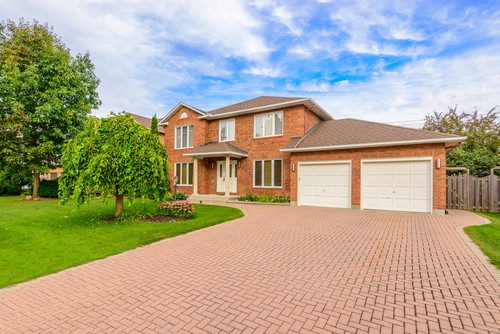
Discover why Long Island homeowners choose brick driveways over asphalt for lasting beauty, safety, and value.
Share:
Summary:
The numbers don’t lie. While asphalt driveways typically last 15-20 years and require sealing every 3-5 years, quality brick driveways can serve your home for 25+ years with minimal maintenance. That’s not just longevity—that’s smart economics.
But durability isn’t the only advantage. Brick driveways offer immediate usability. No waiting 48-72 hours like with asphalt or 7-10 days like concrete. Your new driveway is ready the moment installation is complete.
The safety factor matters too, especially for families. Brick’s naturally textured surface provides superior traction in wet conditions, while asphalt becomes slippery and can soften dangerously in summer heat.
Yes, brick driveways cost more upfront—typically $18-$23 per square foot in Nassau County compared to $3-$4 for asphalt. But here’s what most contractors won’t tell you about the true cost comparison.
Asphalt requires sealing every 3-5 years at $400-$800 per application. Factor in crack repairs, resurfacing, and eventual replacement, and your “budget” asphalt driveway becomes expensive fast. Meanwhile, brick driveways require minimal maintenance beyond occasional cleaning and joint sand replenishment.
When individual pavers do need replacement—rare with quality installation—you’re looking at spot repairs, not complete driveway replacement. Try doing that with cracked concrete or deteriorated asphalt. The math becomes clear: brick driveways deliver better long-term value despite higher initial investment.
Consider this: if your asphalt driveway needs sealing twice and one major repair over 15 years, you’re looking at additional costs of $1,500-$3,000. Add replacement costs, and brick starts looking like the economical choice.
The property value boost matters too. Real estate professionals consistently report that quality hardscaping, including brick driveways, increases home values significantly more than basic asphalt installations.
Yes, brick driveways cost more upfront—typically $18-$23 per square foot in Nassau County compared to $3-$4 for asphalt. But here’s what most contractors won’t tell you about the true cost comparison.
Asphalt requires sealing every 3-5 years at $400-$800 per application. Factor in crack repairs, resurfacing, and eventual replacement, and your “budget” asphalt driveway becomes expensive fast. Meanwhile, brick driveways require minimal maintenance beyond occasional cleaning and joint sand replenishment.
When individual pavers do need replacement—rare with quality installation—you’re looking at spot repairs, not complete driveway replacement. Try doing that with cracked concrete or deteriorated asphalt. The math becomes clear: brick driveways deliver better long-term value despite higher initial investment.
Consider this: if your asphalt driveway needs sealing twice and one major repair over 15 years, you’re looking at additional costs of $1,500-$3,000. Add replacement costs, and brick starts looking like the economical choice.
The property value boost matters too. Real estate professionals consistently report that quality hardscaping, including brick driveways, increases home values significantly more than basic asphalt installations.
Here’s the reality: a brick driveway is only as good as its installation. The difference between a 10-year disappointment and a 25-year investment comes down to proper base preparation, precise grading, and attention to drainage details.
Long Island’s soil conditions and climate present specific challenges. Clay soils that expand and contract. Freeze-thaw cycles that can shift improperly installed materials. Heavy rains that test drainage systems. These factors demand experience and local knowledge.
Professional installation begins below ground with proper excavation, base material selection, and compaction. The visible brick work represents maybe 30% of the total project—the foundation work underneath determines long-term performance.
Quality brick driveway installation follows a systematic process that takes 3-7 days depending on size and complexity. Understanding what happens at each stage helps you evaluate contractors and set proper expectations.
Day one typically involves site preparation and excavation. This means removing existing materials, establishing proper grades for drainage, and excavating to the required depth. In Nassau County, this usually means going 8-12 inches deep to accommodate base materials and account for frost line considerations.
Base installation happens next. This involves laying and compacting multiple lifts of crushed stone aggregate, typically 4-6 inches total depth. Each lift gets compacted separately using specialized equipment. Shortcuts here cause problems later—settling, uneven surfaces, and premature failure.
The bedding layer comes next—typically 1 inch of fine sand that gets screeded perfectly level. This creates the smooth, uniform surface that ensures proper brick placement and prevents rocking or unevenness.
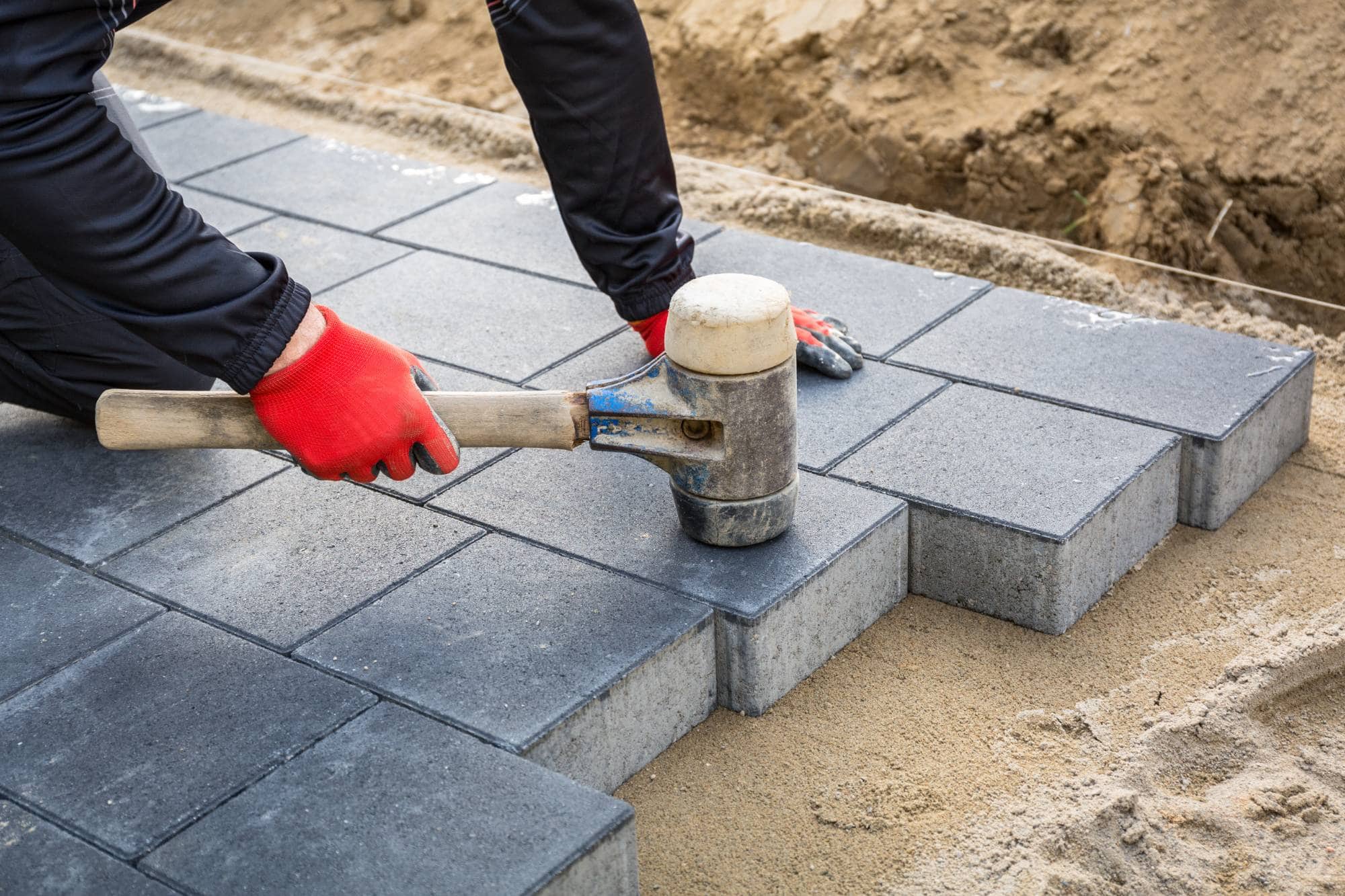
Brick installation requires skill and patience. Each paver must be placed individually, checked for level and alignment, and adjusted as needed. Patterns must stay consistent, joints must maintain proper spacing, and the overall surface must remain true to grade.
Edge restraints get installed to prevent spreading over time. These aren’t visible in the finished project but they’re critical for long-term stability. Quality installations use commercial-grade restraints, not just concrete edges that can crack and fail.
Final steps include joint sand installation, compaction, and cleanup. Polymeric sand gets swept into joints and activated with water to create a stable, weed-resistant surface that still allows for drainage and movement.
Not all brick driveway installations are created equal. Understanding common mistakes helps you choose the right contractor and avoid costly problems down the road.
Inadequate base preparation tops the list. Some contractors cut corners by skipping proper excavation depth or using inferior base materials. Others don’t compact adequately between lifts. These shortcuts might save time initially, but they guarantee problems within a few years.
Improper drainage design causes major issues in Long Island’s climate. Water that can’t drain properly will freeze, expand, and destroy even the best brick installation. We design drainage systems that account for your property’s specific conditions and direct water away from the driveway and your home’s foundation.
Poor edge restraint installation allows pavers to spread over time, creating uneven surfaces and joint problems. Quality installations use proper restraint systems that remain invisible but provide decades of stability.
Incorrect joint sand selection and installation creates ongoing maintenance headaches. Regular sand washes out and allows weeds to grow. Quality polymeric sands resist washout and inhibit weed growth while maintaining the flexibility that brick systems require.
Material quality varies significantly. Not all bricks are suitable for driveway applications. Some are too soft, others don’t handle freeze-thaw cycles well. We source appropriate materials from reputable suppliers and can explain the differences.
Timing matters too. Rushing installation to meet arbitrary deadlines often results in compromised quality. Weather conditions affect installation quality—attempting to install during inappropriate conditions causes problems that might not appear for months or years.
Our experience with local conditions makes a huge difference. Nassau and Suffolk County soil conditions, drainage challenges, and climate factors require specific knowledge that comes from years of local experience.
Your driveway represents a significant investment in your home’s functionality, safety, and value. While the upfront cost of brick driveways exceeds asphalt alternatives, the long-term benefits—durability, safety, aesthetics, and property value enhancement—make brick the smart choice for discerning homeowners.
The key lies in choosing an experienced contractor who understands Long Island’s unique challenges and has the expertise to deliver installations that perform beautifully for decades. With over 20 years of masonry experience in Nassau and Suffolk counties, we bring the knowledge, skills, and commitment to quality that your investment deserves.
Don’t settle for another asphalt driveway that will crack, fade, and require constant maintenance. Invest in a brick driveway solution that enhances your home’s beauty while providing the durability and performance your family needs.
Article details:
Share:
Continue learning: