Driveway Replacement vs Repair: What $5,000 Really Gets You

Cracked driveway, unclear options, and quotes all over the map? Here's what $5,000 actually buys you in Nassau County — and how to make the right call.

Share:

A man in a yellow shirt and overalls, working on a brick wall, showcases the skill of a NY masonry contractor Long Island residents trust.

Creating Beautiful and Functional Outdoor Living Spaces with Bricks, Stones, and Concrete Blocks

Masonry in landscaping is essential to designing and constructing an attractive and functional outdoor living space. Masonry is the art of building structures using bricks, stones, and concrete blocks. It is an ancient trade that has been used for centuries to create structures that are both functional and aesthetically pleasing.

Landscaping is the process of designing, planning, and creating attractive, functional, and sustainable outdoor living spaces. It involves the use of plants, water features, lighting, and other elements to create an outdoor environment that is both beautiful and practical.

Masonry plays a crucial role in landscaping as it helps to create a solid and durable foundation for various outdoor living features such as patios, walkways, retaining walls, fireplaces, and water features. In this blog, we will explore the various ways masonry can be used in landscaping and the benefits it provides.

Patios

Patios are outdoor living spaces typically made of concrete or stone. They are a popular feature in landscaping as they provide a comfortable area for dining, entertaining, and relaxation. Masonry is an ideal material for creating patios as it is durable, low-maintenance, and can be customized to suit any design style.

Masonry patios can be made using a variety of materials such as bricks, stones, and concrete blocks. These materials can be arranged in different patterns and designs to create an attractive and attractive outdoor living space. Masonry patios are also resistant to weathering, erosion, and pests, which makes them a practical and long-lasting option.

Walkways

Walkways are paths that lead from one area of the outdoor living space to another. They are typically made of concrete, stone, or pavers and can complement the overall landscaping design. Masonry is an ideal material for creating walkways as it provides a solid and stable surface that can withstand heavy foot traffic and the elements.

Masonry walkways can be made using a variety of materials such as bricks, stones, and concrete blocks. These materials can be arranged in different patterns and designs to create an attractive and attractive walkway that complements the overall landscaping design. Masonry walkways are also low-maintenance and can be easily cleaned and repaired if necessary.
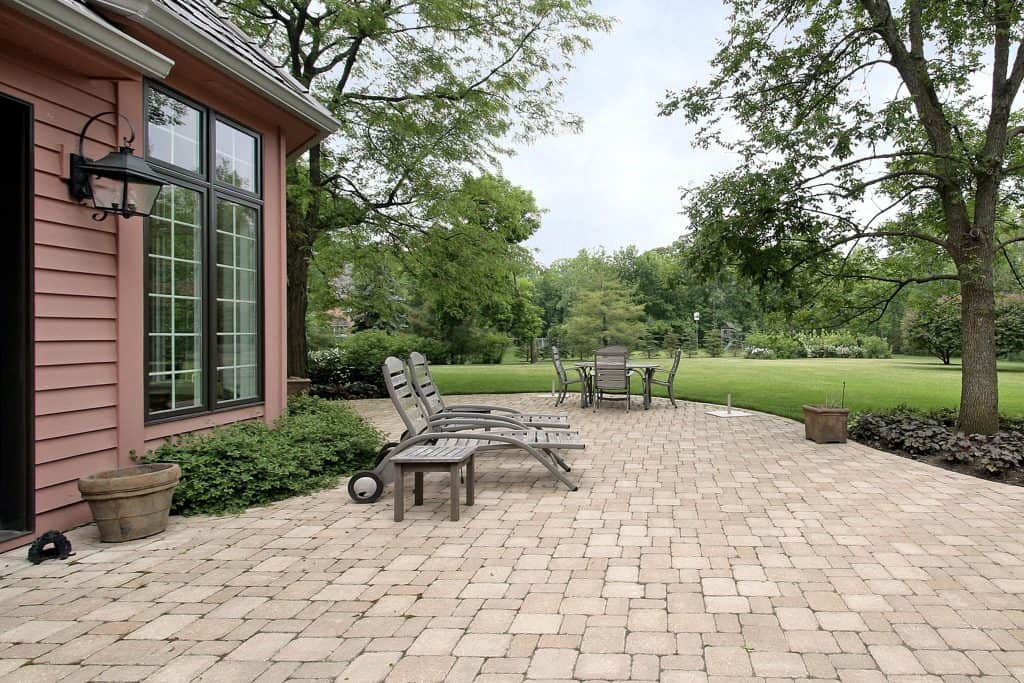
A spacious brick patio, expertly crafted by a masonry contractor Long Island, NY, features lounge chairs and a dining table set. It’s bordered by a red house and overlooks a large green lawn with trees in the background.

Retaining Walls

Retaining walls are structures designed to hold back soil and prevent erosion. They are a crucial feature in landscaping as they help maintain the integrity of the outdoor living space. Masonry is an ideal material for creating retaining walls as it is strong, durable, and can be customized to suit any design style.

Masonry retaining walls can be made using a variety of materials such as bricks, stones, and concrete blocks. These materials can be arranged in different patterns and designs to create an attractive and attractive foundation wall. This complements the overall landscaping design. Masonry retaining walls are also low-maintenance and durable, making them a practical and long-lasting option.

Fireplaces

Fireplaces are outdoor living features that provide warmth and cozy atmosphere for dining and entertaining. Masonry is an ideal material for creating fireplaces as it is heat-resistant and can be customized to suit any design style.

Masonry fireplaces can be made using a variety of materials such as bricks, stones, and concrete blocks. These materials can be arranged in different patterns and designs to create an elegant and attractive fireplace. This complements the overall landscaping design. Masonry fireplaces are also low-maintenance and durable, making them a practical and long-lasting option.

Summary:

Deciding between driveway repair and full replacement is rarely straightforward — especially when quotes vary wildly and the damage looks different every spring. This post breaks down what your budget actually covers in Nassau County, how to read the real warning signs, and why the cheapest bid almost never saves you money. Understanding the difference between a surface fix and a structural problem can save you thousands. Whether you’re dealing with hairline cracks or full-on alligator patterning, we’ll help you figure out what you’re actually looking at — and what to do about it.
Table of contents

Every spring in Nassau County, the same thing happens. The snow melts, the salt dries up, and suddenly your driveway looks worse than you remembered. Maybe the cracks are wider. Maybe there’s a new section that’s sinking. Maybe you’ve patched the same spot twice already and you’re tired of throwing money at something that keeps coming back.

The real question isn’t whether something needs to be done — it’s whether you’re fixing the problem or just delaying it. We’ll help you figure out which situation you’re actually in, what different options realistically cost here on Long Island, and what separates a smart investment from an expensive mistake.

Driveway Repair Cost: What You're Actually Paying For in Nassau County

When homeowners in Nassau County start getting quotes, the range can be genuinely confusing. One contractor says $1,500. Another says $6,000. Neither one fully explains why. The gap usually comes down to what’s actually being addressed — the surface, or what’s underneath it.

Surface-level repairs like crack filling and patching typically run $2 to $3 per square foot. Resurfacing — where a new layer is applied over the existing driveway — lands between $3 and $7 per square foot. Both options make sense when the underlying base is structurally sound. When it isn’t, those same repairs are just buying you another year or two before the problem returns, usually worse.

Full driveway replacement in Nassau County runs higher than national averages. Asphalt installation typically falls between $7 and $15 per square foot installed. Concrete runs $7 to $14 per square foot for a standard slab. Pavers start around $20 and climb from there depending on material and design. For a standard two-car driveway, you’re looking at $4,200 to $9,000 for asphalt, and $7,200 to $15,000 for concrete — before demolition of the existing surface.

A worker in blue overalls and gloves holds a stack of five square concrete paving stones, arranged largest to smallest, at a NY construction site with paving slabs and bricks for a masonry contractor Long Island project.

Concrete Driveway Repair Cost: When Fixing It Makes Sense — and When It Doesn't

Concrete is durable, but it’s also unforgiving. It doesn’t flex the way asphalt does, which means when the ground shifts — and in Nassau County, it does, every single winter — concrete cracks rather than bends. That’s not a flaw in the material; it’s just physics. The question is what kind of crack you’re dealing with and what caused it.

A small, isolated crack with clean edges is usually a surface issue. Filling it with a compatible concrete repair product costs under $300 in most cases and genuinely extends the life of an otherwise sound driveway. Left alone, though, that same crack lets water in. Water freezes. Freeze-thaw cycles widen the gap. What cost $50 to address in October can turn into a $5,000 subgrade failure by the following spring. That’s what we see regularly on Long Island properties where small issues were ignored through one too many winters.

Partial slab replacement — where one or two sections are removed and repoured — typically runs $600 to $1,500 per section. That’s a reasonable option when damage is isolated and the rest of the driveway is structurally intact. But if multiple sections are failing, or if the base beneath them is compromised, you’re often better off with a full replacement. Pouring new concrete over a bad foundation is like replacing a few shingles on a roof with rotted decking — it looks fine until it doesn’t.

Concrete driveways that are 25 years or older and showing widespread cracking, heaving, or surface spalling are almost always replacement candidates. Nassau County’s housing stock skews older — much of it built in the 1950s through 1970s — which means a significant number of driveways in communities like West Hempstead, Hempstead, and North Hempstead are already at or past that threshold. If yours is in that range, an honest assessment matters more than another patch job.

What Does $5,000 Actually Buy You for Driveway Work in Nassau County?

This is the question worth answering directly, because $5,000 means very different things depending on your driveway’s size, material, and condition.

For a smaller asphalt driveway — say, a single-car or compact two-car layout around 400 square feet — $5,000 can cover a full replacement, including demolition of the existing surface and proper base preparation. At $7 to $15 per square foot installed, a 400-square-foot asphalt driveway lands between $2,800 and $6,000. So yes, $5,000 is a realistic budget for a complete asphalt replacement at that scale.

For a standard two-car driveway closer to 600 square feet, $5,000 gets you into the lower end of the asphalt replacement range — but it won’t cover concrete or pavers at that size. What it will cover is a full resurfacing of a concrete driveway in good structural condition, or targeted concrete repairs across multiple sections. It could also cover a paver repair or partial replacement if the damage is isolated.

What $5,000 will not cover is a full concrete replacement on a two-car driveway, which typically runs $7,200 to $15,000 in this market. And it won’t cover a paver installation on a full driveway, which starts around $11,400 and climbs quickly depending on material selection. Knowing this upfront helps you have a realistic conversation with any contractor.

The honest answer is that $5,000 is a meaningful budget for driveway work in Nassau County, but what it buys depends entirely on what you’re actually dealing with. That’s why an in-person assessment matters before any number gets thrown around. Surface appearance alone doesn’t tell the full story.

Driveway Crack Repair: Reading the Damage Before You Decide Anything

Not all cracks are created equal, and the type of cracking you’re seeing is one of the most reliable indicators of what kind of repair — if any — will actually hold.

Hairline cracks along the surface, especially in concrete, are common and often manageable. They typically result from normal curing, minor settling, or temperature changes, and they don’t necessarily signal structural trouble. Sealing them promptly keeps water out and slows progression. The mistake is assuming all cracks are this benign.

The cracks that signal deeper problems are the ones that form a web or interconnected pattern — sometimes called alligator cracking because of how it looks. That pattern almost always means the base underneath is failing. No surface repair fixes a failing base. If you’re seeing that kind of cracking across a significant portion of your driveway, you’re likely looking at a full replacement, not a patch.

Why Nassau County Winters Accelerate Driveway Damage More Than Most People Realize

A modern house with wooden paneling and a partially completed stone patio showcases the skilled work of a masonry contractor Long Island, NY; pavers, stacks of bricks, and construction tools are visible beside a gravel area in the front yard.

Long Island’s climate is harder on driveways than most homeowners account for. Nassau County sits close enough to the Atlantic and Long Island Sound that it deals with elevated coastal moisture year-round — and that moisture finds every crack it can during the winter months. When temperatures drop below freezing, that water expands. When temperatures rise again, it contracts. This freeze-thaw cycle repeats dozens of times between November and March, and each cycle widens existing cracks and stresses the slab further.

Add road salt to that picture. Nassau County roads are heavily treated during winter storms, and that salt migrates onto private driveways — especially at the apron where your driveway meets the street. Salt is particularly corrosive to concrete, accelerating surface spalling and weakening the slab over time. Asphalt is somewhat more tolerant, but it’s not immune. Nor’easters compound the issue by requiring heavy snow removal, which can physically damage driveway surfaces, especially older asphalt that’s already brittle.

The practical implication is that a driveway that looks manageable in October can deteriorate significantly by April. What was a repairable crack in the fall can open into a structural problem after a hard winter. This is why we recommend addressing visible damage before winter sets in rather than waiting to see how bad it gets — because on Long Island, it usually gets worse.

If your driveway is already past 15 years and showing moderate cracking, the math often favors replacement over continued repair. Repeated patching on a driveway approaching the end of its lifespan is money spent delaying the inevitable, and each winter in Nassau County shortens that runway further.

How to Tell If a Driveway Quote Is Legitimate — or a Warning Sign

This is the part most contractors won’t tell you, but it’s worth knowing before you sign anything.

When quotes vary dramatically — and in Nassau County, it’s common to see bids that are $3,000 to $5,000 apart for the same project — the difference almost always comes down to base preparation, material quality, or both. A contractor who bids 30 to 50 percent below everyone else isn’t finding efficiencies you can’t see. They’re cutting something: the depth of the gravel base, the thickness of the surface layer, the quality of the materials, or all three. A driveway installed on a thin or poorly compacted base will crack and settle within a few years, and you’ll be starting this process over again.

Nassau County requires a Home Improvement Contractor License for driveway installation and replacement work — administered through the Nassau County Office of Consumer Affairs. That’s a verifiable credential, not just a claim on a website. Before any work begins, ask to see a valid license number and proof of general liability insurance and workers’ compensation coverage. If a contractor can’t produce those, that’s not a minor detail to overlook.

Written contracts matter too. Any project over $500 should have a written agreement that specifies materials, base depth, drainage approach, timeline, and what cleanup looks like when the job is done. Vague flat-rate quotes without material specifications are a red flag. So are large upfront cash deposits and pressure to sign before you’ve had time to think.

We’ve been doing this work in Nassau County for over 20 years. Our workers are background-checked and drug-tested, and an owner is on-site for every project — not a crew you’ve never met. We also handle permitting as part of the process, because navigating Nassau County’s municipal requirements on your own is an unnecessary headache. We’re not the cheapest option in this market, and we don’t try to be. But we do show up, do the work right, and stand behind it.

Making the Right Driveway Decision for Your Nassau County Home

The repair-versus-replace decision comes down to three things: how old the driveway is, what kind of damage you’re actually dealing with, and whether the base underneath is still structurally sound. Surface appearance is only part of the picture. A driveway that looks rough might have years of life left with the right repair. One that looks okay from the street might be sitting on a failing foundation.

What you don’t want is to spend money on a repair that doesn’t hold, or rush into a full replacement when a targeted fix would have done the job. Both mistakes are common, and both are avoidable with an honest assessment upfront.

If you’re in Nassau County — whether you’re in South Farmingdale, New Cassel, West Hempstead, or anywhere in between — and you’re trying to figure out what you’re actually dealing with, reach out to us for a free consultation. We’ll tell you what we see, what your options are, and what makes sense for your specific situation. No pressure, no guesswork.

Article details:

Share: