Why Driveway Companies’ Low Quotes Signal Hidden Problems

Not all driveway quotes are created equal. Here's what Nassau County homeowners need to know before signing anything.

Share:

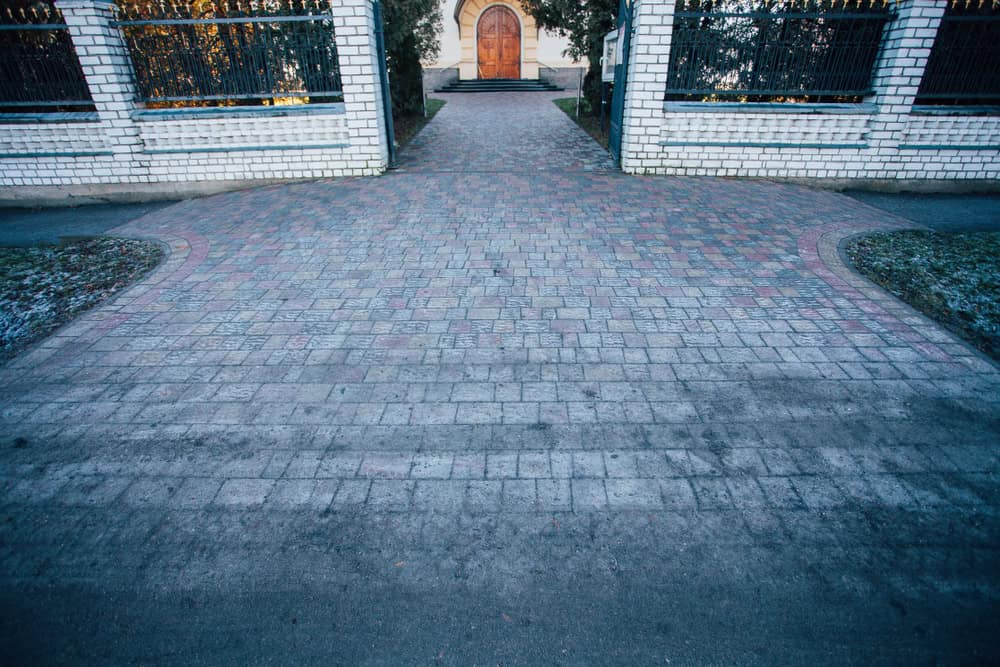
Close-up of a sidewalk paved by a masonry contractor Long Island in NY, featuring interlocking rectangular bricks in a geometric pattern, leading toward a grassy area with sunlight casting reflections on the surface.

Creating Beautiful and Functional Outdoor Living Spaces with Bricks, Stones, and Concrete Blocks

Masonry in landscaping is essential to designing and constructing an attractive and functional outdoor living space. Masonry is the art of building structures using bricks, stones, and concrete blocks. It is an ancient trade that has been used for centuries to create structures that are both functional and aesthetically pleasing.

Landscaping is the process of designing, planning, and creating attractive, functional, and sustainable outdoor living spaces. It involves the use of plants, water features, lighting, and other elements to create an outdoor environment that is both beautiful and practical.

Masonry plays a crucial role in landscaping as it helps to create a solid and durable foundation for various outdoor living features such as patios, walkways, retaining walls, fireplaces, and water features. In this blog, we will explore the various ways masonry can be used in landscaping and the benefits it provides.

Patios

Patios are outdoor living spaces typically made of concrete or stone. They are a popular feature in landscaping as they provide a comfortable area for dining, entertaining, and relaxation. Masonry is an ideal material for creating patios as it is durable, low-maintenance, and can be customized to suit any design style.

Masonry patios can be made using a variety of materials such as bricks, stones, and concrete blocks. These materials can be arranged in different patterns and designs to create an attractive and attractive outdoor living space. Masonry patios are also resistant to weathering, erosion, and pests, which makes them a practical and long-lasting option.

Walkways

Walkways are paths that lead from one area of the outdoor living space to another. They are typically made of concrete, stone, or pavers and can complement the overall landscaping design. Masonry is an ideal material for creating walkways as it provides a solid and stable surface that can withstand heavy foot traffic and the elements.

Masonry walkways can be made using a variety of materials such as bricks, stones, and concrete blocks. These materials can be arranged in different patterns and designs to create an attractive and attractive walkway that complements the overall landscaping design. Masonry walkways are also low-maintenance and can be easily cleaned and repaired if necessary.
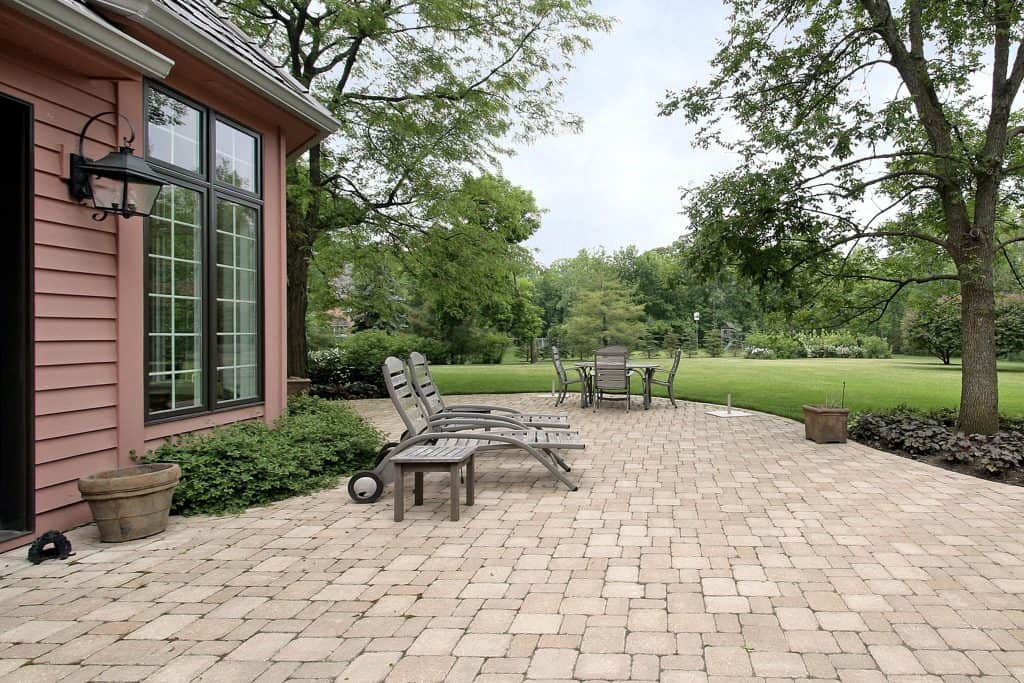
A spacious brick patio, expertly crafted by a masonry contractor Long Island, NY, features lounge chairs and a dining table set. It’s bordered by a red house and overlooks a large green lawn with trees in the background.

Retaining Walls

Retaining walls are structures designed to hold back soil and prevent erosion. They are a crucial feature in landscaping as they help maintain the integrity of the outdoor living space. Masonry is an ideal material for creating retaining walls as it is strong, durable, and can be customized to suit any design style.

Masonry retaining walls can be made using a variety of materials such as bricks, stones, and concrete blocks. These materials can be arranged in different patterns and designs to create an attractive and attractive foundation wall. This complements the overall landscaping design. Masonry retaining walls are also low-maintenance and durable, making them a practical and long-lasting option.

Fireplaces

Fireplaces are outdoor living features that provide warmth and cozy atmosphere for dining and entertaining. Masonry is an ideal material for creating fireplaces as it is heat-resistant and can be customized to suit any design style.

Masonry fireplaces can be made using a variety of materials such as bricks, stones, and concrete blocks. These materials can be arranged in different patterns and designs to create an elegant and attractive fireplace. This complements the overall landscaping design. Masonry fireplaces are also low-maintenance and durable, making them a practical and long-lasting option.
Summary:

A low quote from a driveway company can feel like a win — until the driveway starts cracking two winters later. This post breaks down what actually drives driveway costs in Nassau County, why cheap bids almost always cut corners you can’t see, and what separates a contractor worth hiring from one worth avoiding. Understanding the real numbers — and the real risks — puts you in a much stronger position before anyone sets foot on your property.
Table of contents

You got three quotes. One came in noticeably lower than the others. Now you’re wondering if the other two contractors are overcharging you — or if something’s off with the cheap one.

That’s exactly the right question to be asking. In Nassau County, where winters are brutal, soil conditions are unforgiving, and labor costs run well above the national average, a driveway that’s installed on the cheap rarely stays intact for long. We break down what driveway installation actually costs, what separates a legitimate quote from a low-ball one, and what to look for before you hire anyone.

Asphalt Driveway Price Per Square Foot: What's Actually Driving the Number

Asphalt is the most common driveway material in Nassau County, and for good reason — it handles freeze-thaw cycles reasonably well, costs less upfront than concrete or pavers, and can last 15 to 20 years when it’s installed correctly. The operative phrase there is “installed correctly.”

For a new asphalt installation, expect to pay somewhere between $7 and $13 per square foot, with full residential driveways in Nassau County typically landing between $5,000 and $12,000 depending on size, site conditions, and drainage requirements. Replacing an existing driveway — which involves demolition and removal — runs closer to $8 to $15 per square foot because you’re paying for the old material to come out before anything new goes in.

When a quote comes in well below that range, the savings have to come from somewhere. Usually, it’s the base.

A spacious brick patio, expertly crafted by a masonry contractor Long Island, NY, features lounge chairs and a dining table set. It’s bordered by a red house and overlooks a large green lawn with trees in the background.

Average Cost of a New Driveway — and Why Nassau County Runs Higher Than the National Average

Nationally, the average asphalt driveway costs around $5,276 according to HomeAdvisor. In Nassau County, that number climbs — and it’s not arbitrary. Labor rates in the New York metro area run 20 to 40 percent above national averages, and Nassau County’s specific soil and climate conditions require more careful site preparation than you’d find in a milder market.

The base layer is where most of the cost — and most of the corner-cutting — happens. A properly installed driveway needs four to eight inches of compacted gravel beneath the asphalt surface. That base is what carries the load, manages drainage, and protects the surface from the freeze-thaw cycles that hit Long Island every winter. When water seeps under a thin or poorly compacted base, it freezes, expands, and pushes up through the surface. That’s not a maintenance issue — that’s a structural failure, and it happens faster than most homeowners expect.

Nassau County’s soil doesn’t help matters. Clay-heavy ground — common across central Nassau and along the South Shore in communities like Oceanside, Merrick, and Bellmore — doesn’t drain the way sandy soil does. Water sits longer, which means drainage design isn’t optional. It’s the difference between a driveway that holds up and one that develops soft spots and cracks within a few years.

A contractor who quotes you significantly less than others is almost certainly thinning out the base, skipping proper drainage grading, or both. You won’t see it happening — the work is underground — but you’ll feel it by year three or four when the surface starts to heave and crack. At that point, you’re not patching a driveway. You’re replacing one.

Average Cost to Replace a Driveway — and What Removal Actually Adds to the Bill

If your current driveway needs to come out before a new one goes in, that removal cost is real and it’s separate from the installation itself. Demolition and hauling typically adds $1 to $3 per square foot to the total project cost. For a standard two-car driveway in Nassau County, that can mean an additional $600 to $2,400 on top of the installation price — a line item that low-ball contractors often leave out of their initial quote entirely.

Some contractors will offer an asphalt overlay instead — applying a new surface layer over the existing one. At $3 to $7 per square foot, it’s tempting. But an overlay only makes sense when the existing base is structurally sound. Paving over a damaged or unstable base is cosmetic work. It looks fine for a season, maybe two, and then the underlying problems push right back through.

This is one of the most common scenarios we see in Nassau County: a homeowner gets a cheap overlay, the surface deteriorates quickly, and now they need a full replacement — paying twice for what should have been done right the first time. A legitimate contractor will assess your existing base before recommending overlay versus full replacement. If someone quotes you an overlay without ever looking at what’s underneath, that’s worth questioning.

The other thing removal pricing reveals is whether a contractor is accounting for disposal properly. Asphalt and concrete debris can’t just disappear — it has to be hauled and disposed of legally. Contractors who skip that cost in their quote are either planning to cut corners on disposal or they’ll add it back as a surprise charge later.

Cement Driveway Cost in Nassau County: The Case for Paying More Upfront

Concrete driveways cost more than asphalt to install — typically $6 to $15 per square foot for standard gray concrete, with decorative or stamped finishes pushing into the $20 to $25 range. The national average for a full concrete driveway installation sits around $6,400, but in Nassau County, where labor costs run higher, a two-car concrete driveway more realistically lands between $8,000 and $15,000 depending on finish and site conditions.

The upside is longevity. A well-installed concrete driveway lasts 25 to 40 years — significantly longer than asphalt. For homeowners in communities like Garden City, Great Neck, or Manhasset, where median home values are well above $700,000, that lifespan math often makes concrete the smarter long-term investment. The higher upfront cost amortizes over decades rather than years.

What Affects Concrete Driveway Pricing Beyond the Material Itself

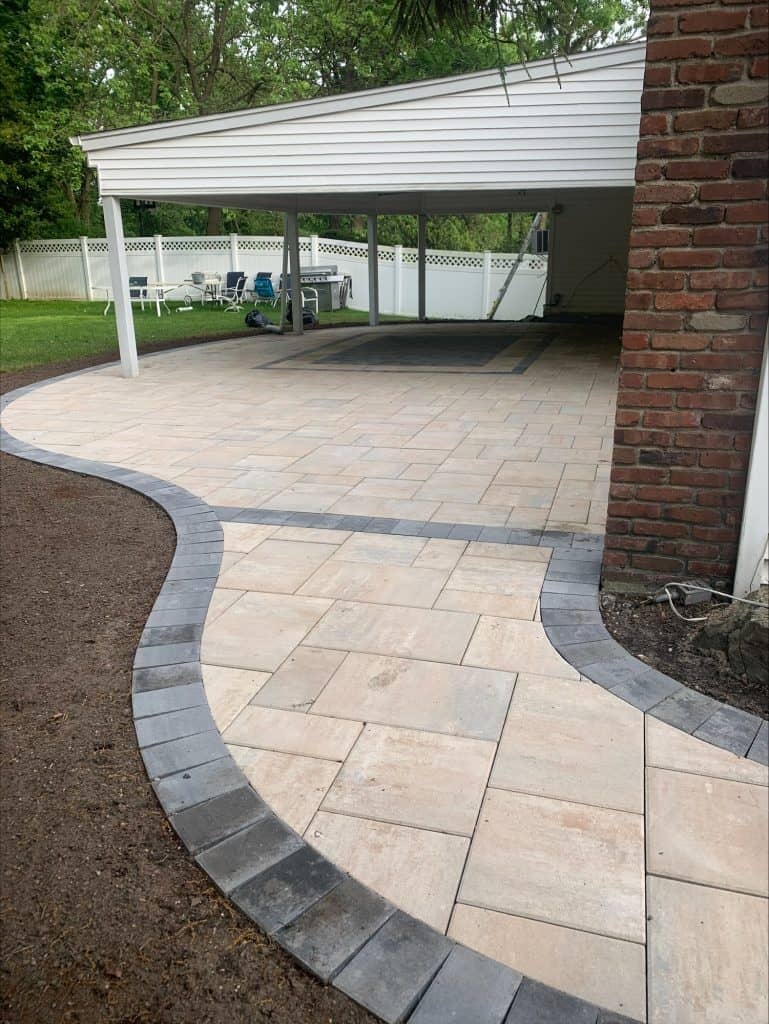
A patio by a top masonry contractor Long Island curves around a brick wall, featuring light-colored rectangular pavers bordered with dark gray. It extends to a covered NY outdoor area with white columns, with grass and chairs visible in the background.

Labor makes up 40 to 60 percent of a concrete driveway’s total cost, which means the quality of the crew doing the work has a direct impact on the final number — and on how long the driveway lasts. Concrete installation is less forgiving than asphalt. It requires proper reinforcement (wire mesh, rebar, or fiber), correctly spaced control joints to manage cracking, and careful curing. Rush the curing process or skip the reinforcement, and you’ll see cracking within a few years regardless of how good the concrete mix was.

Drainage matters here too, arguably more than with asphalt. Concrete is rigid — it doesn’t flex with ground movement the way asphalt does. In Nassau County, where freeze-thaw cycles create constant ground pressure, a concrete driveway installed without proper drainage grading and base preparation will crack. Not might crack. Will crack.

This is why comparing concrete quotes purely on price per square foot misses the point. A quote that looks favorable on paper may be skipping reinforcement, using a thinner slab (three inches instead of the standard four to six), or ignoring drainage entirely. None of that is visible in the quote — and none of it shows up in the finished surface until the damage is already done. When you’re evaluating concrete bids, the questions to ask are about process: How deep is the base? What reinforcement are you using? How are you handling drainage away from the foundation? A contractor who can answer those questions clearly is a contractor who actually knows what they’re doing.

How to Vet Driveway Companies in Nassau County Before You Sign Anything

Nassau County requires all home improvement contractors — including driveway installers — to be licensed through the Nassau County Department of Consumer Affairs. That’s not a formality. To qualify for that license, a contractor has to demonstrate at least five years of experience working under a licensed contractor. It’s a meaningful credential threshold, and it’s one that unlicensed operators can’t meet.

You can verify any contractor’s license status through the Nassau County Office of Consumer Affairs before you agree to anything. An unlicensed contractor working in Nassau County can’t legally enforce a contract or pursue payment through the courts — which means they have very little accountability if the work goes sideways. That’s not a risk worth taking on a $7,000 to $12,000 project.

Beyond licensing, a few other things are worth confirming before anyone starts work. General liability insurance and workers’ compensation coverage protect you if something goes wrong on your property — without them, you could be liable for injuries that happen on your job site. Ask for certificates of insurance, not just verbal assurances.

The other thing that matters, and that most homeowners don’t think to ask about, is whether the owner will actually be present during the project. There’s a wide gap in the industry between the person who sells you the job and the crew that shows up to do it. When the owner is on-site, there’s direct accountability for the quality of the work. When the owner is elsewhere and the crew is unsupervised, quality control becomes an assumption rather than a guarantee. It’s a simple question that tells you a lot about how a company actually operates.

We’ve been doing this work in Nassau and Suffolk counties for over 20 years. Every worker on our crew is background-checked and routinely drug-tested — because your home is your property, and you deserve to know who’s on it. Our owners are present during projects, not just available by phone. And we specialize in paving and masonry, which means this isn’t a side service we offer between other jobs. It’s what we do.

Choosing the Right Driveway Company in Nassau County, NY

A low quote isn’t always dishonest — but it’s always worth understanding. When a bid comes in significantly below the others, the question isn’t whether to feel good about it. The question is where the savings are coming from. In most cases, it’s the base, the drainage, the materials, or the permits. Those aren’t details. They’re the entire reason a driveway lasts or doesn’t.

Nassau County’s climate, soil conditions, and licensing requirements make contractor selection more consequential here than in many other markets. The homes are valuable, the winters are hard, and the cost of doing it twice is real.

If you’re ready to get a straight answer on what your project actually involves and what it should realistically cost, reach out to us. We’ll walk your property, give you an honest assessment, and explain exactly what’s included — no vague estimates, no surprise line items.

Article details:

Share: